




You Know More Than ChatGPT Does. That’s Why The Answers Can Feel Vague
There is a particular moment that seems to happen sooner or later when you start using ChatGPT for your business.
You ask it to write something, suggest an idea or help you think something through, and the answer comes back perfectly competent. There is nothing obviously wrong with it. The grammar works, the structure makes sense and there may even be a sentence in there that you rather like.
Yet you still find yourself looking at it and thinking, Yes... but that isn’t quite me.
Perhaps it has used language you would never normally use. Maybe the suggestion would suit another business perfectly well but feels slightly misplaced in yours. It may have misunderstood the person you are talking to, made an assumption about what you sell or given you the kind of polished marketing copy that technically ticks all the boxes while sounding as though it belongs to somebody else entirely.
So you explain a little more. You tell ChatGPT who your audience is and ask it to try again. The next version is better. Then you remember that your audience is mostly made up of beginners, which changes the way you want things explained, so you add that as well. You mention the product you are talking about, the tone you prefer and perhaps one or two words you would happily never see again.
Before long, the quick question you dropped into ChatGPT has somehow turned into an introduction to half of your business.
If that sounds familiar, there is a good reason for it.
ChatGPT Knows A Lot, But It Doesn’t Automatically Know Your Business
This is one of the easiest things to forget about AI. We open ChatGPT and there it is, ready to respond to almost anything we type into the box. Because it answers so quickly and with such confidence, it can feel as though all the important knowledge is already there.
In many ways, it is. ChatGPT can work with an enormous range of subjects, ideas and information. But there is a very important difference between knowing about business and knowing your business.
It does not automatically know what you sell, who you speak to, what matters most to you, how you like to sound, what you have already tried or where you are hoping to go next. Unless those details have been shared, ChatGPT has to work with whatever information happens to be available in that particular conversation.
When you think about that in human terms, it makes complete sense. Imagine somebody arriving to work with you for the first time. You would not sit them at a desk on Monday morning, hand them a laptop and say, “Could you write Thursday’s customer email?” without telling them anything else.
They would need to know what the email was about, who receives it, what you are promoting, what has already been said and how your business normally communicates. They may need to understand the product, the customer and the reason for the email before they could create anything that genuinely sounded as though it belonged to your business.
Nobody would consider those questions a sign that the new person was incapable. We would simply understand that they had not been introduced to the business yet.
Somehow, though, it is very easy to expect something quite different from AI.
The Question Is Only Part Of The Story
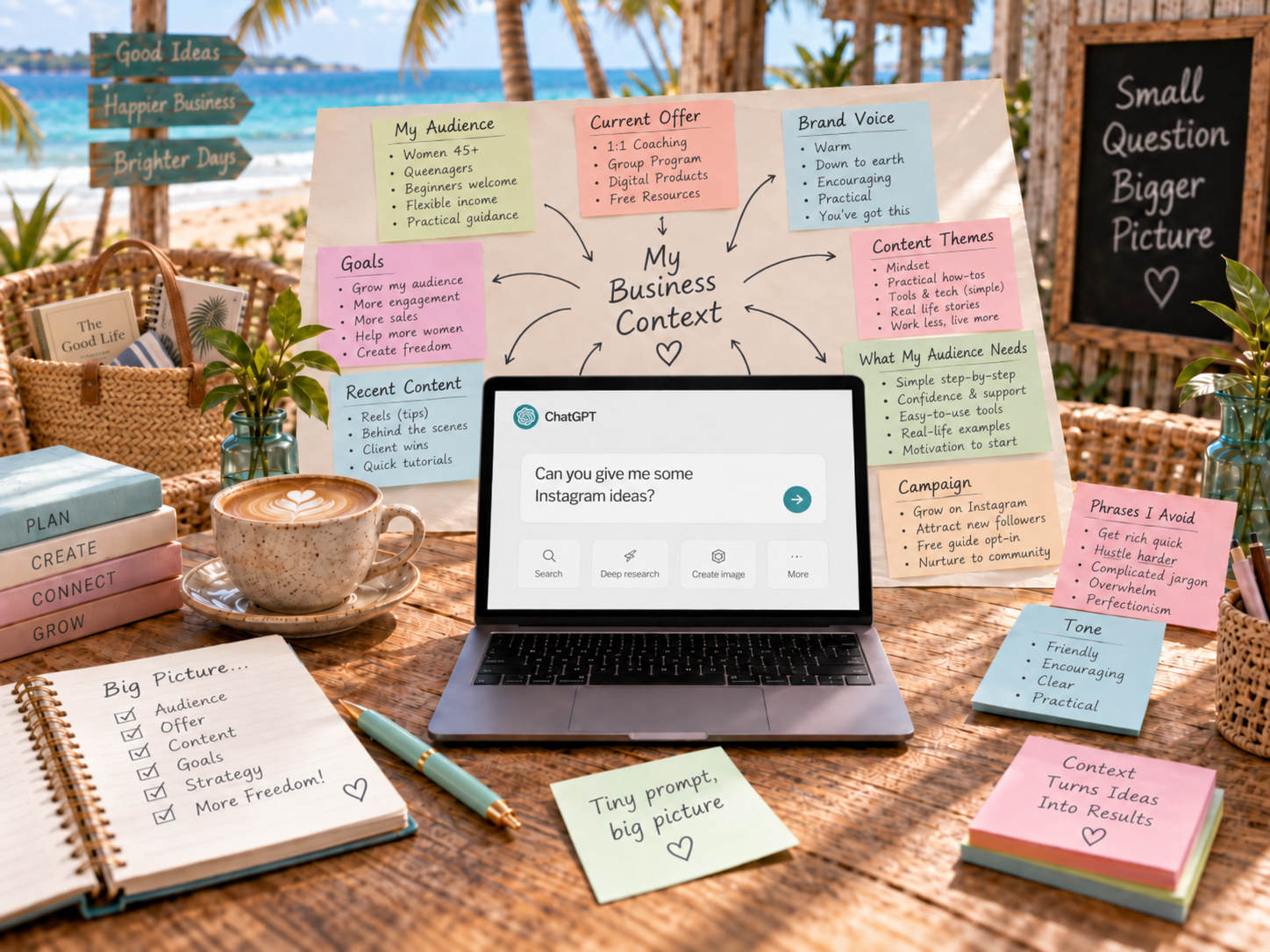
Let’s say you type something as straightforward as, Can you give me some Instagram ideas?
To you, that question may feel perfectly clear because you already know the business behind it. You know who follows the account, what you have spoken about recently, what you are currently selling, what your audience tends to respond to and which phrases would make you wince if they appeared in a caption. ChatGPT does not know any of that unless you have already told it.
You may also know that a particular product needs more visibility this week, that a free download is part of the current campaign or that you want the next few posts to feel less promotional and more conversational. All of that knowledge is living in your head while you type one short sentence.
ChatGPT sees the sentence.
That is where the gap begins.
You are asking the question with the whole history and personality of your business sitting behind it. ChatGPT is responding with whatever information it has been given so far. The question itself may be simple, but the meaning behind it is not.
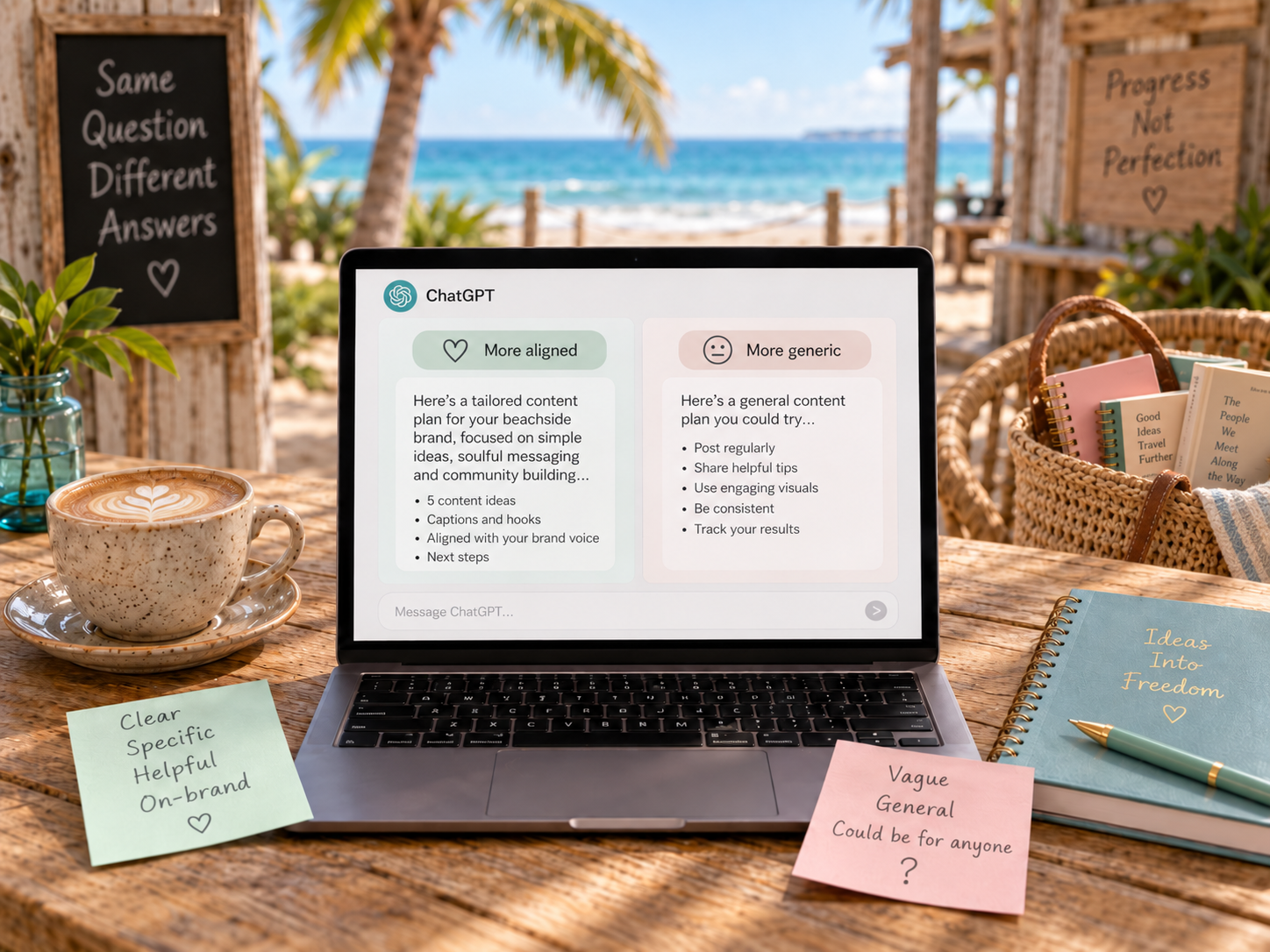
This is why the same prompt can produce something that feels useful in one conversation and oddly generic in another. The difference is often not the wording of the question. It is the amount and quality of the business context available around it. The guide goes much further into this distinction, but the principle is simple: the more ChatGPT understands about the world your question belongs to, the less it has to fill in for itself.
And once you see that, the whole relationship with AI starts to make more sense.
Why Does It Seem To Get You One Day And Not The Next?
This can be one of the stranger parts of using ChatGPT regularly.
One conversation can feel almost uncannily useful. The ideas are relevant, the language feels closer to your own and the conversation seems to move in the right direction with very little effort. You may even find yourself thinking, Yes, that is exactly what I meant.
Then another conversation feels completely different. You ask what seems like a similar question and receive something so broad that you wonder where yesterday’s version of ChatGPT has disappeared to.
It probably has not disappeared anywhere.
What has changed is the information available around the question.
When ChatGPT has enough relevant context to work with, its responses can feel much more connected to what you had in mind. Sometimes that context has been provided deliberately. Sometimes it has accumulated naturally through a longer conversation. When information is missing, ChatGPT has to make broader assumptions in order to respond.
That is often where those perfectly acceptable but strangely impersonal answers come from. The copy may sound polished, but it does not sound like you. The idea may be usable, but it does not quite fit the business. The direction may be reasonable, but it feels as though it was written for a vague version of your audience rather than the people you actually speak to.
This is also why the hunt for the perfect prompt can become a bit of a distraction. Prompts matter, of course, but even the cleverest wording cannot magically contain every decision, preference and piece of knowledge you have gathered about your business over time.
A prompt may be one sentence long. The understanding behind it is much bigger.

The Repeating Yourself Part Can Become A Faff
This is often the point where the novelty begins to wear off.
You have already explained who your audience is. You have already described the product. You have already said that you do not want everything to sound like an advertisement. You have explained the style you prefer, the language you dislike and the direction the business is taking. You may even have spent time refining something until it finally sounded right.
Then another conversation begins and there you are again, reintroducing everybody.
Nothing is necessarily going wrong. The difficulty is that you are still carrying the bigger picture. You remember what worked last time, what you decided, which direction you chose and what matters most to the business. When that context is not available to ChatGPT, the responsibility for putting all of those pieces back on the table remains with you.
That can become surprisingly tiring because the whole reason for using AI is usually to make certain parts of the work easier, faster or more useful. If every conversation starts with a lengthy recap, the experience begins to feel less helpful than it ought to.
You can end up using ChatGPT in short bursts rather than as something you return to regularly. It still has value, but constantly getting it back up to speed can begin to feel like another task on the list.
And that is where an important shift in thinking starts to appear.

Perhaps The Prompt Isn’t The True Starting Point
At some stage, it becomes useful to stop asking yourself, How do I write a better prompt? and start asking a different question instead.
What would ChatGPT need to understand about my business in order to give me a better reply?
That is a much more useful place to begin, because business does not happen as a collection of disconnected tasks. An Instagram post connects to an audience, a product, a message and the way the business wants to be recognised. The email you are writing today may connect to something you launched three months ago, while the product you are discussing now may fit into a much longer plan.
You can see all of those connections because you created them. They are obvious to you because they have developed through decisions, conversations, experiments and experience. ChatGPT needs enough information to see how those pieces fit together before it can respond in a way that feels genuinely connected to the business behind the question.
That does not mean handing over every tiny detail. It does not mean writing a company manual before you ask for help. It simply means recognising that the question itself is only one part of the conversation.
Perhaps the issue is not that you are bad at prompting, or that ChatGPT is behaving unpredictably for no reason. It may simply be that you are asking it to work inside a business it has never properly been introduced to.

What Changes When The Introduction Gets Better?
Once ChatGPT has more useful context, it has fewer gaps to fill in for itself. The tone can come closer to what you had in mind, the suggestions can feel more relevant to where the business actually is and the conversation can move forward without so much correcting and re-explaining.
The free guide explores this in much more depth, including how better context affects tone, direction and the usefulness of the responses you receive.
For the purpose of this article, though, the important part is simpler. The better the introduction, the less time you spend looking at an answer and thinking, That is close, but not quite right.
You can start working with the response instead of constantly rebuilding it. The conversation becomes less about repairing misunderstandings and more about developing the thing you actually opened ChatGPT to work on.
That is a very different experience.
It also gives you a much more useful question to ask when a response misses the mark. Instead of assuming the prompt was wrong, you can ask what information ChatGPT may have been missing when it answered.
That small change in perspective can make AI feel much less mysterious.
So What Does ChatGPT Actually Need To Know?
And this is where I am deliberately going to stop, because this is the point where the next question becomes much more interesting than another blog paragraph.
What information matters most?
How much is enough?
Why do some conversations feel more useful than others?
What happens when context is missing?
How do you make the whole experience feel more consistent without turning AI into another complicated thing to manage?
Those were exactly the questions that led me to put together
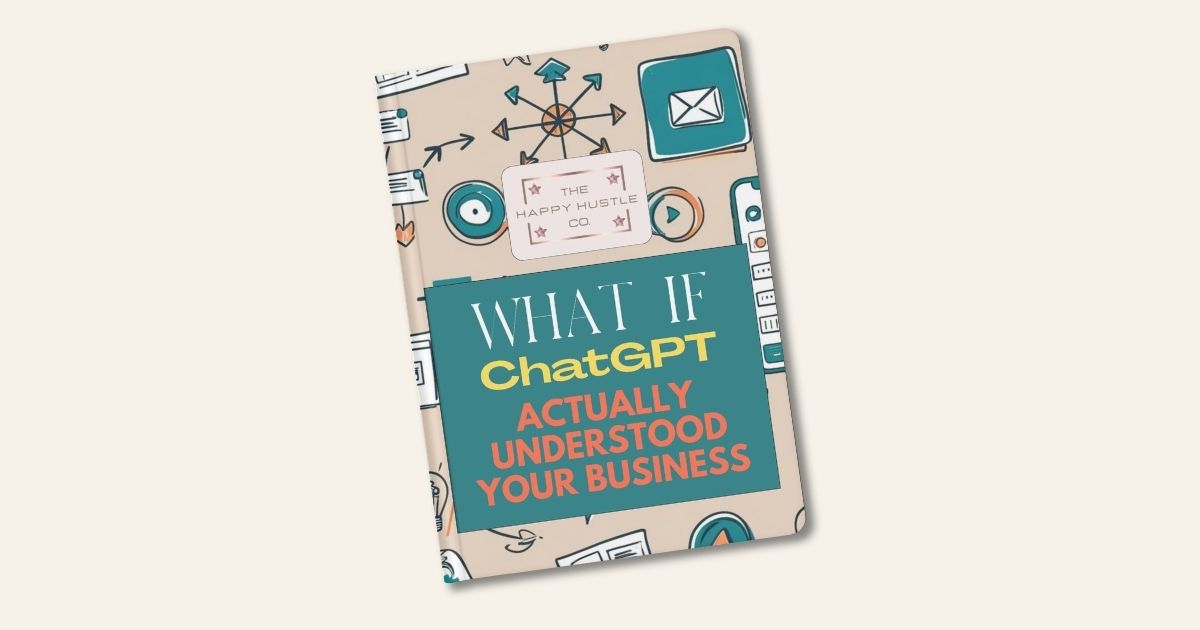
What If ChatGPT Actually Understood Your Business?
It is a FREE guide from The Happy Hustle Co that takes this idea much further.
It looks at why ChatGPT can feel useful one day and vague the next, what changes when it has better context and how to start guiding the conversation in a more useful way.
There are practical examples inside too, along with a mini prompt library designed to show how context, intention and direction can change the responses you receive.
But the real starting point is much simpler than any prompt library.
If you decide you would like to get into this further, the free guide introduces you to Chip Chatsworth at the end. Chip is The Happy Hustle Co’s virtual assistant, created to help you work through ideas, organise your thoughts and keep the bigger business picture in view as you go. He does not give isolated answers. He helps the conversation get started and stay connected, so you are not constantly starting from zero every time you need support.
One of the first things Chip does is guide you through a Business Snapshot, giving him the essential context he needs to understand what you are working on, who it is for and how you like to approach things. From there, the conversation has a much stronger foundation.
So, if you have ever looked at a ChatGPT response and thought, You still do not quite get what I mean, perhaps the answer is not another clever prompt.
Perhaps it is time ChatGPT and your business were properly introduced.
Let us know what you think in the comments!




Categories
Fancy Staying in Touch?
Pop your email below and I'll send you the occasion email with new ideas, resources
& other useful bits & bobs you might like.
By joining, you acknowledge that you'll receive our emails and can opt-out
anytime hassle-free.
Built on a wing & a prayer by ©thehappyhustleco